 Phoenix
 InvoiceKitPDF invoices for people who work for themselves
Invoicing clients in another country
You closed a deal with a client abroad and now you have to bill them. Here is what the document needs, a worked example, and how to issue one from your phone in seconds.
Free · no account · your data stays on your device
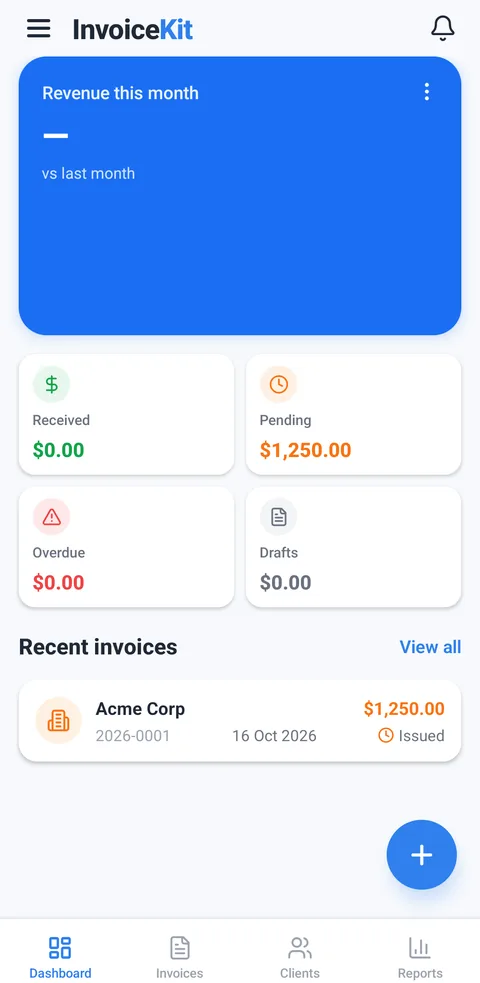
What is still open 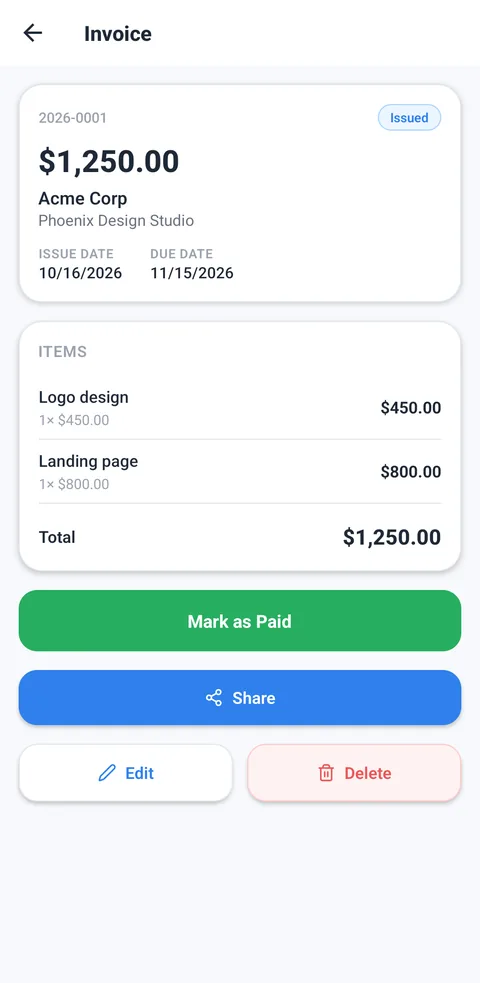
The invoice itself 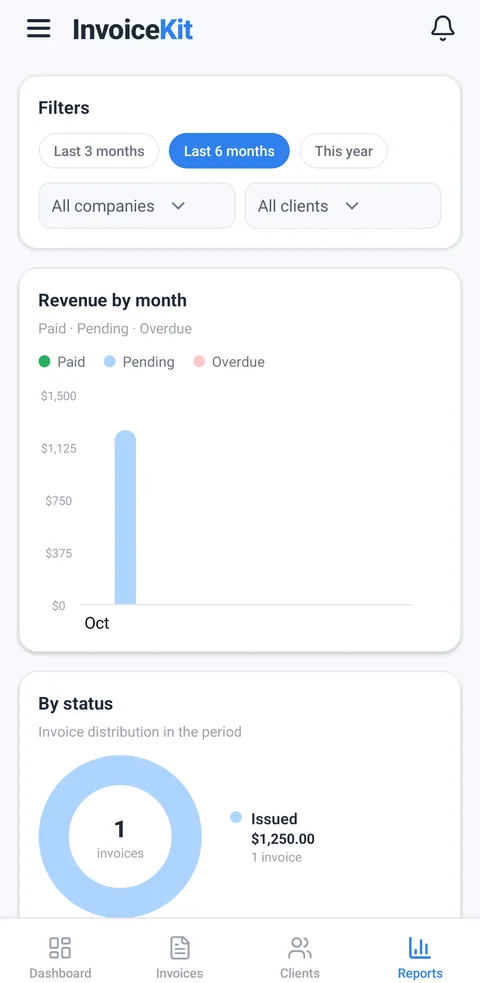
Revenue by period
An invoice is not a receipt, and not a tax document
An invoice is the commercial request for payment: who did the work, who hired it, what was delivered, how much it costs, in which currency and by when. It is what your client's accounts payable needs in order to pay you, and what a bank or payment provider will often ask for to justify money coming in from abroad.
A receipt is proof that payment happened — it comes after. And in many countries there is also a tax document that only the government's own system can issue; the invoice does not replace it. Which one applies to you depends on where you are registered, not on where your client is.
This page is informational and is not tax or legal advice. Before your first cross-border invoice, check with an accountant in your own country what you are required to issue.
What an international invoice must include
There is no official template, but there is a set of fields clients expect — and that banks tend to check. A missing one usually means the invoice comes back for correction, and payment slips by weeks.
- The word Invoice and a number. Sequential, no gaps, never reused. It is how both sides refer to this particular bill.
- Your full details: legal name, address including country, e-mail, and your tax ID if you have one.
- Your client's details, the same way — legal name, address, country, and their tax ID (VAT, EIN, ABN) when they have one. Ask for it; B2B buyers expect the question.
- Issue date and due date. Spell the month out (16 Oct 2026): 03/04 reads as 3 April in most of the world and 4 March in the United States.
- A concrete description of the work. "Consulting" invites questions; "Landing page design and build — 2 rounds of revision" settles them.
- Quantity, unit price and line subtotal, so the client can check the maths without writing to you.
- The currency, spelled out on every amount. A bare "$" is ambiguous — write
USD 1,250.00,EUR,BRL. - Tax, withholding or reverse-charge notes, when they apply, on their own line below the subtotal.
- The total due, stated once and hard to miss.
- Payment terms: Net 15, Net 30 or Due on receipt, and who pays the transfer fee. Agreeing on that up front is how you avoid arriving 30 dollars short.
- How to pay you: your international account details, Wise, Payoneer, PayPal, or full bank details with SWIFT/IBAN.
A worked example
Invoice 2026-0001 · Issued 16 Oct 2026 · Due 15 Nov 2026
From: Phoenix Design Studio — São Paulo, Brazil · Tax ID 00.000.000/0001-00
To: Acme Corp — Austin, TX, United States
| Description | Amount |
|---|---|
| Logo design — 1 × USD 450.00 | USD 450.00 |
| Landing page — 1 × USD 800.00 | USD 800.00 |
| Total due | USD 1,250.00 |
Terms: Net 30. Bank charges payable by the sender.
Payment: Wise — Phoenix Design Studio — USD account 0000000000 ·
Routing 000000000.
That is the shape the app produces as a PDF, with your logo at the top and the numbering carried forward on its own.
Getting the money across the border
The invoice is the document; the money travels separately, and the route changes how much of it survives. Three that freelancers actually use:
- A multi-currency account (Wise, Payoneer and the like). Your client pays as if it were a domestic transfer, and you convert when you choose. Usually the cheapest option for small and mid-sized amounts.
- PayPal. The easiest for a client to accept and generally the most expensive once the fee and the exchange spread are counted. Worth it when the amount is small and the friction matters more.
- International bank transfer (SWIFT). The classic route for larger amounts and long contracts. The bank will often ask for the invoice as supporting evidence.
All three cost something — a fee, an exchange spread, sometimes a local tax on the conversion. Price that in before you agree on a number, and put in writing who pays the transfer fee.
InvoiceKit issues and organises the billing. It does not move money, hold funds or convert currency.
Issue it from your phone, in seconds
Three currencies
Real, dollar and euro — and the PDF language follows the currency, so a client abroad gets the invoice in English with nothing to translate.
Automatic numbering
The sequence continues on its own, per company and per client, which is what prevents duplicates and gaps.
PDF through your own share sheet
E-mail, WhatsApp, anything your phone can share to.
Service catalog
Price and unit saved once; the next invoice takes two taps.
Recurring billing
Weekly, monthly or custom, with reminder notifications — so a retainer does not depend on your memory.
Dashboard and reports
Outstanding, received this month and overdue, split by currency, with reports by period, company and client.
Multiple companies
Each with its own logo, for anyone billing under more than one entity.
Your data stays with you
A local database on the device. No account, no sign-up, no connection needed to issue an invoice.
Frequently asked questions
What should an invoice to a foreign client include?
Your details and your client’s, both with country; an invoice number; the issue and due dates; a concrete description of the work with quantity and unit price; the currency written out on every amount; the total due; payment terms; and how to pay you. Anything missing tends to come back as a question and delays payment.
Is an invoice the same as a receipt?
No. An invoice asks for payment and comes first. A receipt confirms that payment happened and comes after. Many clients will ask for both, and some countries also require a separate tax document that only the government system can issue.
Which currency should I invoice in?
Whichever you agreed with the client, usually theirs — dollar and euro cover most cases. What matters is writing the currency code next to every amount (USD 1,250.00), because the dollar sign alone is used by more than ten countries.
What do payment terms like Net 30 mean?
Net 30 means the full amount is due 30 days after the invoice date. Net 15 is 15 days, and Due on receipt means immediately. State who pays the bank charges as well — on an international transfer those run roughly 15 to 40 dollars, and without a line about it they come out of your side.
Do invoice numbers have to be sequential?
Yes, and they should never repeat. The number is how you and the client refer to the same bill, how a payment gets matched to a document, and in many countries it is a legal requirement. InvoiceKit keeps the sequence per company and per client, restarting each year.
Can I invoice international clients from my phone?
Yes. InvoiceKit builds the PDF on the device and shares it through your phone’s own share sheet. There is no account to create and no connection required to issue an invoice — the data lives in a local database on your device.
Start with your next invoice
InvoiceKit is free, asks for no account and keeps everything on your device. The optional InvoiceKit Pro subscription removes ads and unlocks unlimited invoices and companies, your logo on the PDF, and CSV export.
Available for Android and iPhone.
More from PhoenixDev
We build custom software and run our own apps on both stores. See all products or find out what we do.